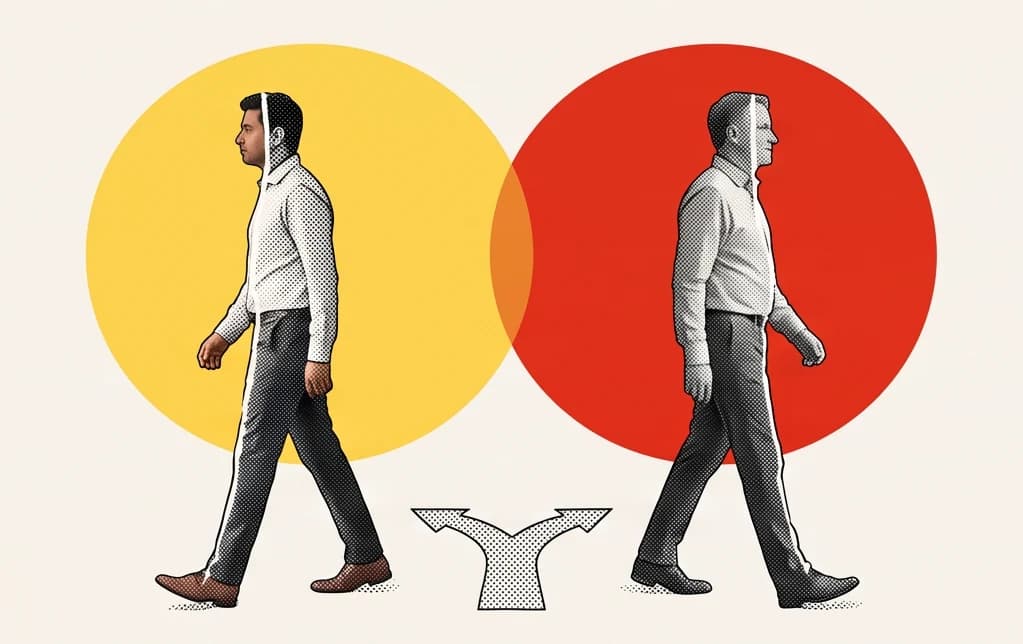
When cofounders disagree about direction, stop arguing about the answer and look at the evidence together. Name what kind of disagreement it is, put what you both know on the table, use a decision owner you agreed in advance, and write down what would make you change course. Most direction fights loop because none of those steps happened.
Why do direction disagreements matter so much?
Because they are the most common reason founding teams split. Embroker's guide to cofounder disputes cites a figure that 71 percent of founders who split blamed differences of opinion on the company's direction.
It rarely starts as a clean debate. One of you wants to move into a new market. The other wants to keep selling the current product. Customers get a different answer depending on which of you they talk to. Every roadmap meeting and every hire becomes a proxy for the real question.
Is this really about direction?
Check first. A direction disagreement is about where the company goes: which customer, which product bet, pivot or persevere. It is narrower than two things it gets confused with:
- Funding. How to pay for the company you already agreed to build. See when cofounders disagree about raising money.
- Values. Who you want to be and how you operate. See cofounder values misalignment.
The fix differs. A values gap needs a conversation about standards. A direction split needs a decision process that starts from evidence, not from the conclusion each of you already holds.
How do you separate evidence from conviction?
Agree on what you both know before anyone argues for an outcome. The disagreement is rarely about whether the data matters. It is about what the data means.
Flat growth can mean the market is wrong. It can also mean you have not given the current plan enough time or enough sales effort. Both readings are reasonable, and neither can be proven this week. That is why the argument loops.
Sit down with the real material:
- Retention and churn for the last two quarters.
- Notes from recent sales calls, including the lost ones.
- What customers ask for that you do not build.
- What already works that you would lose by changing course.
This will not force agreement. It does change the conversation from "I think we should pivot" against "I think we should stay" to a shared look at what is known. Structured cofounder conflict resolution works the same way.
Who decides when you still disagree?
The person you agreed would decide, before the disagreement began. Two reasonable people with the same evidence can still land in different places. Teams that get through this had a rule ready.
Common models:
| Model | How it works | Watch for |
|---|---|---|
| CEO decides | CEO makes the final call on direction after a joint review | The other founder must feel heard first |
| Domain owner decides | Product owner decides product bets, commercial owner decides market | A strong objection triggers a pause, not a veto |
| Outside tie-break | A named advisor or board member weighs in once you are stuck | Give them evidence, not a side to pick |
Pick one while you still agree. A Y Combinator founder put it plainly in YC's advice for first-time founders: "you need to determine how decisions will be made before starting a company together." Cofounder decision making covers how to set this up.
What if the same argument keeps coming back?
Then it was never settled. You landed on a plan, and three weeks later you are arguing it again because one of you agreed out loud to make the tension stop.
Go back to what each of you believes about the market, said separately from what you are willing to say to keep the peace. A shared picture of the facts, agreed before you argue about what to do, stops most of this.
Then write the decision down: what you chose, why, and what evidence would make you look at it again. Set a date to review it. A decision with a review date is much easier to commit to than one that feels permanent, and it stops either of you reopening it every time a month disappoints.
If you are not sure you ever agreed on direction, the free alignment check shows where your answers differ. If the disagreement is already live, a Conflict Session has each of you write your side alone, then read one summary built from both before you agree what changes. For the wider method, see our cofounder conflict resolution guide.
Frequently asked questions
- What is the difference between a direction disagreement and a values disagreement?
- A values disagreement is about who you want to be and how you treat customers, staff and each other. A direction disagreement is about where the company goes: which market, which product bet, whether to pivot. You can share every value and still read the same numbers in opposite ways, so the two need different conversations.
- Who should have the final say when cofounders disagree on strategy?
- Agree this before the disagreement starts. Some teams give the CEO the final call on direction. Others give it to whoever owns the area, product or go-to-market, and let a serious objection from the other founder force a pause, not a veto. The model matters less than choosing it together while you still agree.
- Why do cofounders keep having the same argument about direction?
- Usually one of you agreed to end the discomfort, not because the evidence changed your mind. You settled the words but not the read of the business underneath them. Go back and say, separately, what each of you actually believes about the market, apart from what you are willing to say to keep the peace.
- Can both cofounders be right about where the company should go?
- Often, yes. Founders weigh the same uncertain evidence with different appetites for risk and different information. Neither reading can be proven in the moment. That is why a direction split needs an agreed way to decide and a date to look at the evidence again, instead of a debate that one person has to win.